My first guide, Rama - a short, plump Nepali man of about sixty – got ahold of me in Durbar Square. My initial intent was to wander around the square on my own, but he wouldn’t leave me alone. Looking around, I noticed that there was a multitude of these persistent guides offering their services to single tourists. Before going to Nepal, I had decided to just go with the flow, to let in whatever comes and to let go whatever leaves. So I “gave in” to Rama’s persuasion. Better to have just one guide talking to me than saying no to the whole crowd shouting “buy a tour”. Besides, it was obvious from the look of me that this was my first time here and that I knew absolutely nothing.
Once I stopped fending him off, Rama moved into marketing mode. With great importance, he pulled out a small notebook and began reading client reviews as if they were excerpts from a world constitution. I kept waiting for him to show me Benedict Cumberbatch’s signature from the filming of Doctor Strange, but no. There was even a review from some Ukrainian guy—in Ukrainian. Just to be safe, Rama politely asked me what the review said. Then he announced his price: for this mind-blowing tour, he wanted only 3,000 Nepali rupees (about thirty dollars). “Oh no, thank you,” I said. This Nepali journey was starting to cost me a pretty penny.
Rama didn’t flinch—clearly this wasn’t his first time justifying his rates. He kept pointing at the notebook, where here and there reviews left by his customers said: “I paid 3,000 rupees.” In my head I added: “Confirmed: 3,000 rupees is a fair price for this tour. Bill Gates.” That was Nepali-style marketing.
Seeing that I wasn’t giving in, he met me halfway: fine, 2,500 and we have a deal. “Are you serious?” I said. “That’s still too much.” Rama put on a sad face and said, “I have a special price only for Indian citizens—2,000 rupees. But since you’re so unyielding, I’ll give you an Indian discount.” Right, I thought—probably free for Martians. But out loud I asked, “Do you have a family option? Maybe you’ll give me a sister’s price—1,000?” He realized I’d joined the game and laughed. All right, I thought, America has softened me; I’ve forgotten how to bargain—and I agreed to 2,000 rupees.
It was my first time in Durbar Square, and even with his guidance I couldn’t orient myself. It all looked like a chaotic pile of buildings, structures, and steps. We wandered through narrow alleys, past one row of stalls, then another… It took me a while to realize that all those small “kiosks” with images of gods were actually temples. Even the images of gods and Shiva lingams on the ground were places of worship. Too many sounds, smells, colors brought me a sensory overload.
Rama took me to see Kumari—the living goddess, a girl chosen at the age of three or four, almost like the Dalai Lama. She goes through a series of “tests”; for example, the candidates are frightened in the middle of the night. The one who doesn’t get scared is chosen. The girl is considered a goddess until her first menstruation. Her role is to receive visitors and bless them. She doesn’t see the sun and never steps on the ground. I felt sad—it’s a child, after all. I felt sorry for her. Does she know what she’s been deprived of? Probably not. It’s a great honor for her family and a very clearly defined future for her.
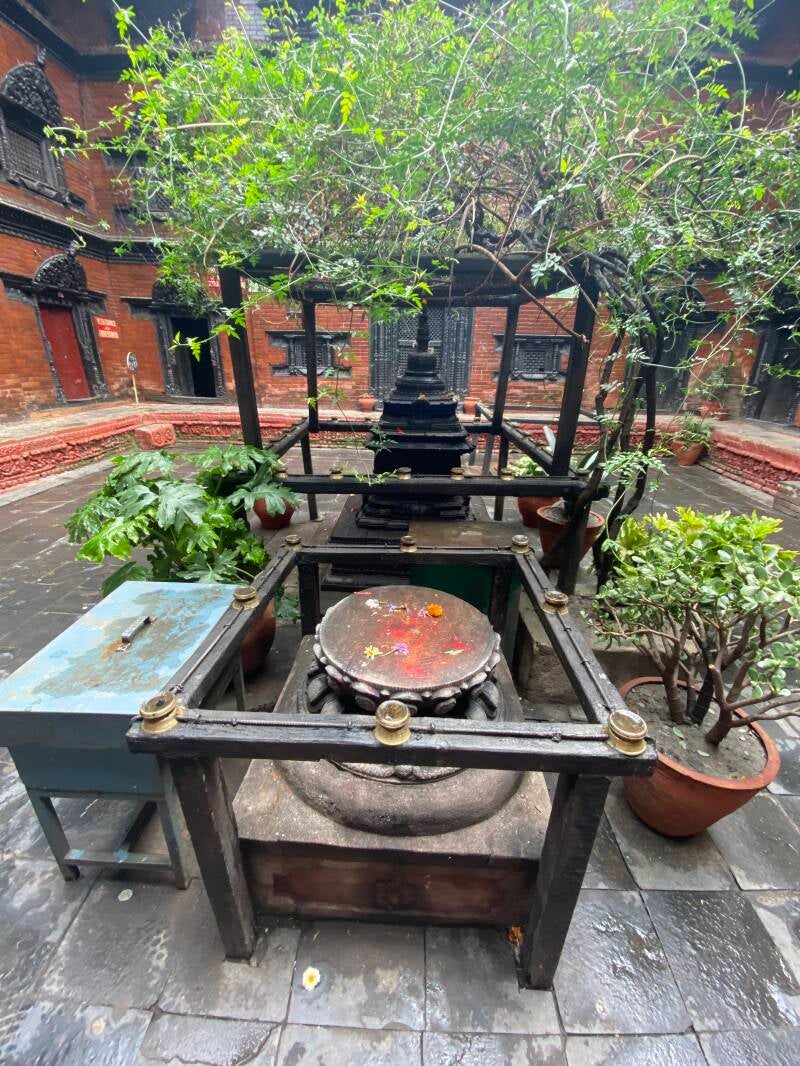
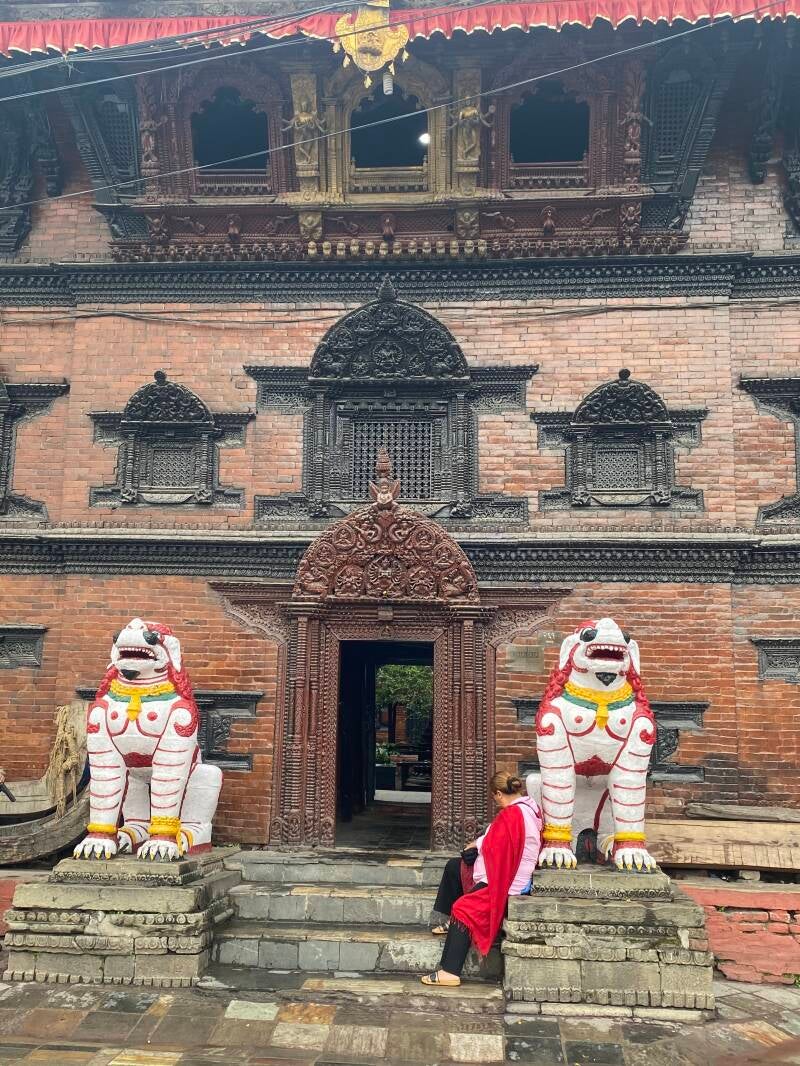
We entered a small courtyard with carved window shutters and intricately carved doors. A crowd of tourists slowly gathered, hoping to see Kumari. She appears on her balcony only twice a day. How fiercely Rama scolded anyone who tried to pull out a camera or phone! How he protected and guarded the little goddess from intrusive visitors! He showed everyone that they needed to be respectful and fold their hands in namaste.
And then, finally, a small, serious face appeared on the second floor of the temple. A girl of about eight or nine looked at the tourists—somewhat detached, yet attentive—one by one, and then just as suddenly turned and disappeared. “What do you think about it?” Rama asked me. “Well,” I said, “I generally respect other people’s rituals, but I have a little girl too, and I’m so happy that she can grow up like a normal child.” “Yes, I understand you,” Rama said, but then added that he felt Kumari had real power. He goes to bow to her once a month and feels recharged with energy. He believed in her power without a doubt.
Then, to make up for the thousand rupees I hadn’t paid him, Rama took me to an art gallery where he earns a commission on sales. I already understood that I had bought a tour bundled with a “TV shopping” feature. And since I had decided to go with the flow and not resist too much, I bought a thangka there—a traditional Nepali painting on cotton fabric depicting a mandala. The painting was stunning.
Why was? That’s a separate story. When I got home, I planned to frame the thangka and hang it on the wall. I unfolded it, showed it to my family—everyone admired it. The painting stayed on a side table, and we went to my daughter’s concert. When we came back, only shreds of my thangka were left. My dog, Patches, apparently decided he was tired of being a dog: “I’ll munch on a mandala and become a Buddha.”
I stood there in shock, checking how angry I was and whether I should move Patches away from me until I reached enlightenment. He looked at me with his big black eyes as if to say, “So, lady boss, which one of us is enlightened now?” “Definitely not me,” I thought. Even a Nepali painting can knock me off my path. But back then I didn’t know any of this and was simply happy to be the owner of a beautiful thangka.
It was time to part ways. Rama wasn’t in a hurry—he was pleased with a good day’s earnings—but I said goodbye and went back to my oasis to rest and digest my impressions.

Add comment
Comments