As a child, I was in love with Roerich’s paintings, where endless ridges of lilac, blue and white mountains told stories of distant sacred lands, where monks, clouds, and immortals live. I dreamed that one day I would see the Himalayas.
When the plane began its descent into Kathmandu, Nepal, I pressed my face against the window, expecting to see those miraculous mountains. But the air was impenetrable. It seemed “hang” there, visible to the eye. A dirty yellow color. Through this smog you couldn’t see farther than a hundred meters. I had never “seen” air before, but here it was visible. And the Himalayas were invisible. They remained somewhere behind a veil of dust, smoke, and other particles—the very things that give Kathmandu’s air quality its rating of “hazardous for sensitive groups.”
This air quality is a separate, sad story for me. I live on the other side of the globe, and it’s hard for me to imagine breathing air like this every day. In New York state, particles from California and Canadian wildfires reach us, and occasionally even Sahara dust arrives across the ocean. You understand, in a way, that we all live on one planet. And there are weeks when you don’t want to go outside without a mask. But in Kathmandu, it’s a completely different level of pollution. There, air quality is usually below acceptable limits. The main causes of smog in Kathmandu are excessive traffic and forest fires.
There is a lot of traffic. Endless cars, motorcycles, minibuses crowd the roads in never-ending traffic jams, barely squeezing past one another at intersections, constantly honking. Many vehicles belch thick smoke from their exhaust pipes, and if you happen to be driving behind one of them, you’d better have an N-95 mask ready.
Kathmandu has expanded several times in just over a decade, but no one planned the city or rethought traffic flow. After the devastating 2015 earthquake, many residents of mountain villages and small towns moved to Kathmandu and joined the endlessly growing tourism industry. They built homes, bought vehicles, and merged into an infrastructure that hadn’t changed at all to accommodate its new users.
“I want to see the Himalayas,” kept circling in my head. I immersed myself in the joyful hum of central Kathmandu, enjoyed the warmth of the temples—but the mountains, the mountains were so close… and yet invisible. I finally encountered the Himalayan foothills on the Kathmandu–Pokhara highway.
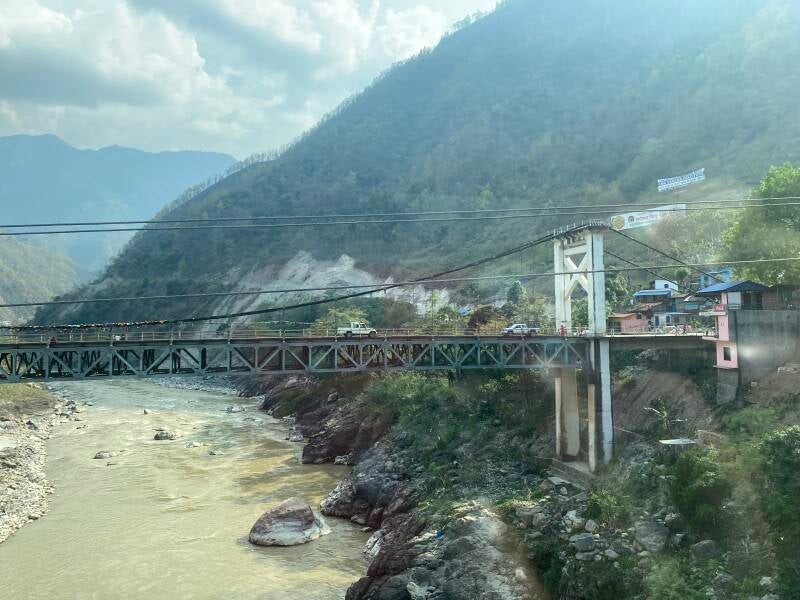
Most tourists come to Nepal to trek in the mountains—from one week to several months, at any level of difficulty. In this regard, the Annapurna massif is especially popular. It’s located near the city of Pokhara, which lies 160 kilometers from Kathmandu—if you measure in a straight line. The winding road through mountains and gorges adds another 40 kilometers. So, 200 kilometers total. You should plan for about 10 hours to be on the road. It may sound long, but once you see the road you’re traveling on, you might think it would be better to go even slower. Traffic jams, roadwork, narrow stretches where it’s best not to look out the window—on one side a mountain wall, on the other a sheer drop. And if you’re on the cliff side, it sometimes feels as though you’re already hanging over the abyss. All of this lengthens the journey. On these narrow sections, cars and buses barely pass each other, honking for a long time and inching forward. On the bus, besides the driver, there’s also an assistant whose job is to keep an extra eye on the road and on passing maneuvers.
Of course, there’s an inexpensive plane that gets you there in 30 minutes, but my group didn’t know that. So we experienced the delights of Nepal’s mountain roads in their full intensity. We did see a bit of the foothills, of course. But the Himalayas themselves were still hiding from me.
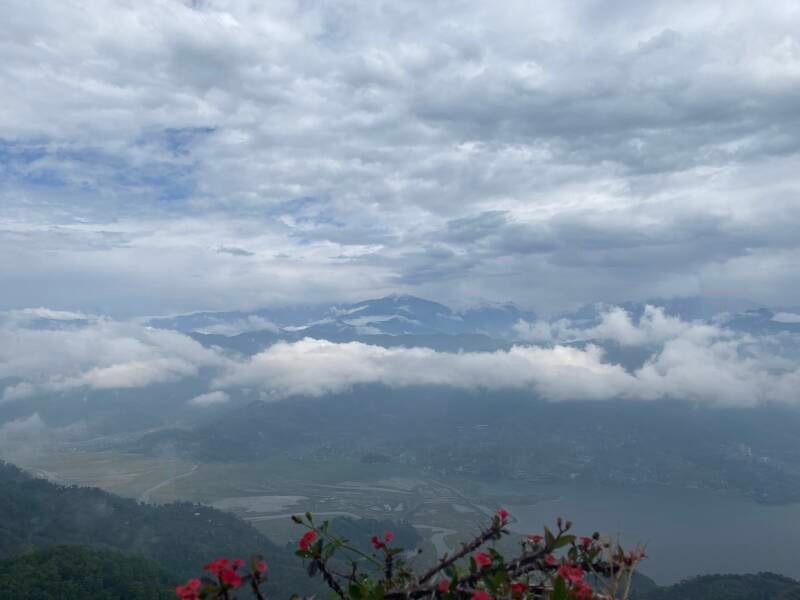
In Pokhara, only the truly lazy skip Sarangkot, where people go to see sunrise over the mountains. Plastic chairs are arranged in neat rows on the viewing platform. Even though we left our hotel at 4:30 a.m., Chinese tourists had already claimed the front row when we arrived. Oh well, we thought—there’s enough sunrise for everyone. It was dark, the platform was square, and it wasn’t really clear from which direction the sun would appear. I took a deep breath and asked myself: where do I feel the mountains? It seemed as if they were everywhere. Minutes passed, the darkness thinned, and below the platform thickets of trees became visible. But the sun couldn’t be seen – the fog grew thicker and thicker. At some point it became clear that we wouldn’t see the sunrise. “Oh no, why?? Where are you, my beloved Himalayas?” They were calling to me and teasing me, they were close—I could feel them—and yet they were invisible. For moments like this, the viewing platform sells fridge magnets: one glance at them and it’s easy to imagine how breathtaking it must be to watch the sunrise in the Himalayas. But I prefer Roerich’s paintings, of course.
The Himalayas revealed their grandeur to me in Pumdikot. And, of course, I finally did see them through the airplane window when I was returning on a small local plane from Lumbini to Kathmandu. But that is a separate story.


Add comment
Comments